

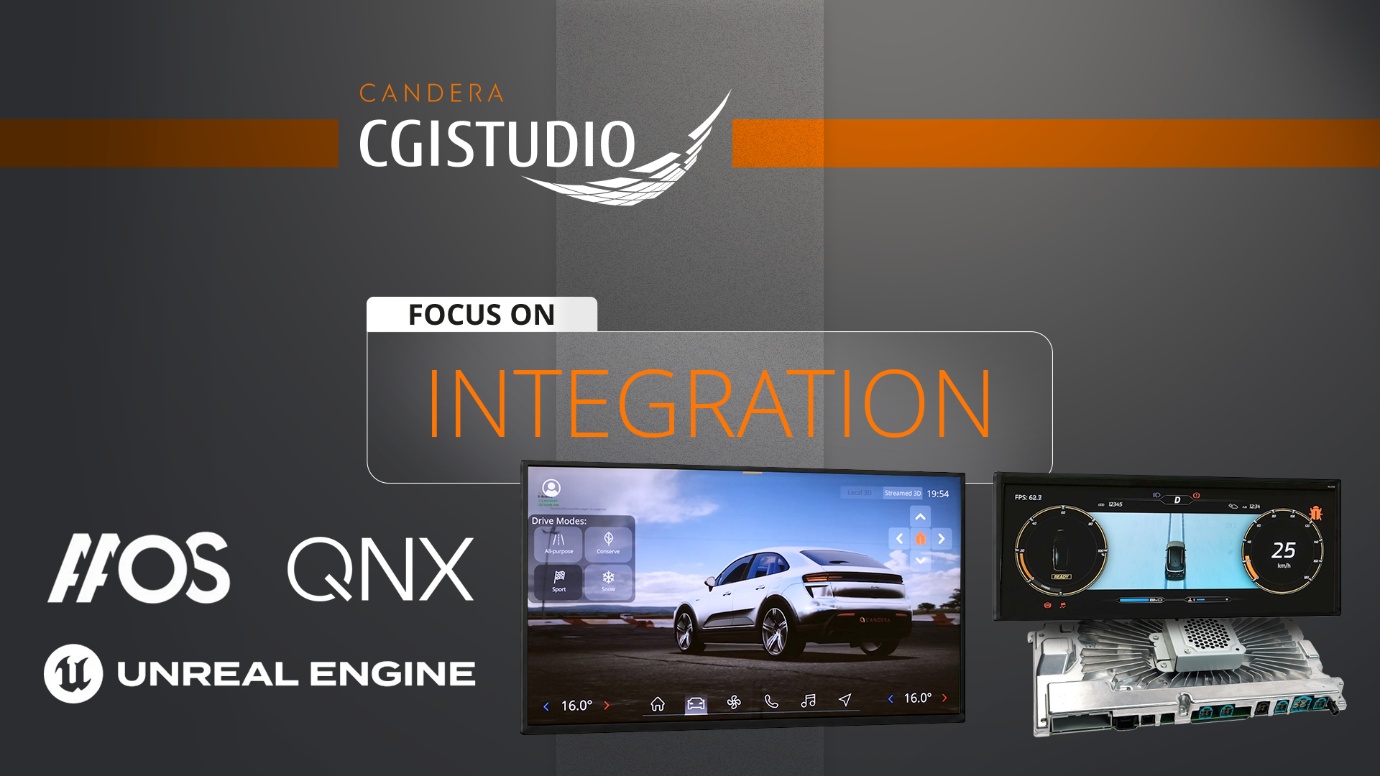
Candera Multi-Domain Cockpit Demo: Integrating Unreal Engine Across Android, QNX and Functional Safety Domains
Software-defined vehicle architectures increasingly combine multiple displays, operating systems and application domains on one centralized computing platform.
Infotainment applications often run in Android Automotive, while instrument clusters, functional safety components, vehicle communication, early graphics and ADAS-related content may operate in QNX, AUTOSAR or other real-time environments.
At the same time, Unreal Engine is increasingly used to create high-fidelity 3D graphics for automotive cockpit applications.
The challenge is not only generating advanced visual content. It is integrating that content efficiently across displays, applications and operating system domains.
The Candera Multi-Domain Cockpit Demo shows how Candera CGI Studio connects Unreal Engine, native embedded 3D visualization, Android Automotive, QNX and functional safety within one integrated architecture.
Unreal Engine in a Multi-Domain Cockpit
Unreal Engine is typically deployed in the Android domain of a software-defined vehicle platform, where it can run in its native environment.
However, many cockpit applications do not run in Android. Instrument clusters, head-up displays, safety-related graphics and real-time vehicle functions may be assigned to other operating system domains.
This creates a central architectural question: How can Unreal Engine content be used across the cockpit without porting and maintaining Unreal Engine separately for every target operating system?
The Candera approach keeps Unreal Engine in the Android domain and makes its rendered output available to CGI Studio applications running in other environments.
CGI Studio applications can execute natively on Android, Android Automotive, Linux, QNX and additional embedded platforms. Unreal Engine content can therefore be integrated across cockpit domains without requiring the engine itself to run in each operating system.
Streaming Unreal Engine Content into CGI Studio
In the Candera Multi-Domain Cockpit Demo, camera output from Unreal Engine 5.6 is streamed directly into a CGI Studio 3D scene.
The stream is displayed on a CGI Studio 3D billboard and becomes part of the complete HMI composition. It can be combined with:
- Native CGI Studio 2D controls
- Native CGI Studio 3D content
- Application logic
- Driver information
- Safety-related graphics
Candera CGI Studio remains responsible for the surrounding HMI, interaction logic and compositing.
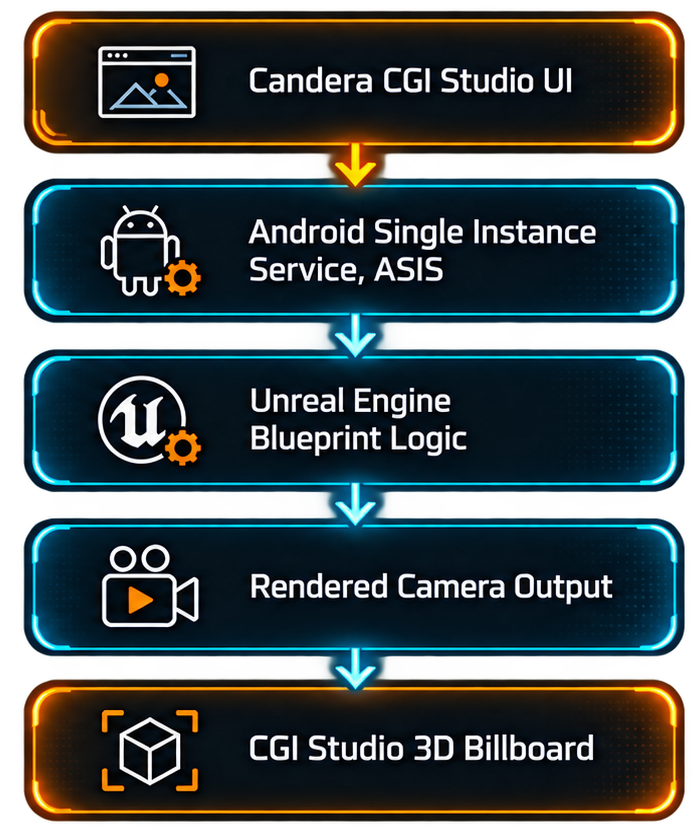
The Unreal Engine scene is controlled through a CGI Studio 2D panel. Controls within the interface trigger Blueprint logic and influence animations, camera behavior, object states and scene parameters.
In this setup, CGI Studio sends control values to Unreal Engine, while Unreal Engine streams its rendered output back to CGI Studio.
The communication flow is:
One Unreal Engine Instance with ASIS
The integration uses the Android Single Instance Service, ASIS, introduced by Epic Games.
Earlier Unreal Engine architectures typically required each application to include its own renderer instance. In a multi-display cockpit, this could result in several Unreal Engine runtimes operating in parallel.
ASIS allows multiple applications to use one central Unreal Engine renderer instance within the Android domain. This reduces duplicated runtime resources and provides a more efficient basis for distributing Unreal Engine content across several displays and applications.
The receiving Candera CGI Studio applications can run in different operating system domains, while Unreal Engine remains in Android.
This also simplifies the update path. New Unreal Engine versions can be introduced within the Android environment without requiring a dedicated engine port for each receiving operating system.
Data Exchange through the Courier Framework
Graphical streaming is only one part of the integration. Automotive applications also need to exchange system states, application data and user input.
Candera CGI Studio uses the Courier Framework for this communication.
Courier is based on an XML-defined data model that describes the values exchanged between the HMI and the underlying application logic. In CGI Studio Scene Composer, these values can be connected to visual properties, animations, application states and touchscreen input.
At build time, backend code is generated to connect the HMI data model with the relevant application sources.
This enables Candera CGI Studio controls to send values to Unreal Engine Blueprint logic while keeping the HMI data model integrated with the surrounding automotive application.
Compositing and Touchscreen Arbitration
Modern cockpit displays often combine content from several applications and rendering technologies.
Candera CGI Studio handles the compositing of native CGI Studio content and streamed Unreal Engine scenes. CGI Studio elements can be placed above or around Unreal Engine content where required.
Typical overlay content includes:
- Driver information
- Navigation elements
- User controls
- Status information
- Functional safety telltales
Candera CGI Studio also manages touchscreen arbitration and determines how input is distributed across the graphical layers and applications.
This keeps interaction logic, user input and driver-relevant information under the control of the embedded HMI framework.
Functional Safety over High-Fidelity Graphics
High-quality 3D graphics and functional safety requirements must coexist within modern automotive displays.
The Candera architecture separates safety-related content from the Unreal Engine rendering path.
Safety-relevant elements such as telltales are created and configured within CGI Studio. They can be composited above Unreal Engine scenes and monitored independently during runtime.
CGI Studio CRC Safety verifies whether the displayed safety-related content matches the expected reference information. If a mismatch is detected, the application can automatically transition into a defined safe state.
This allows high-fidelity Unreal Engine content to be combined with independently monitored safety-related graphics.
Functional Safety across Android and QNX
The Candera Multi-Domain Cockpit Demo includes an interactive functional safety use case running across separate operating system domains.
A dedicated Bug Controller within the Android Automotive IVI application injects display faults into a separate QNX-based functional safety cluster application.
The IVI application forwards values through the shared FusaDemoBugPosition data source to the CGI Studio application running in the QNX cluster domain.
The received value changes the position of monitored content and creates a mismatch between the expected and displayed result.
CGI Studio CRC Safety detects the mismatch and initiates the safe-state response.
The complete sequence is visible in the demo:
- A display fault is initiated in the Android IVI.
- The value is transferred to the QNX application.
- The monitored content is modified.
- CGI Studio CRC Safety detects the mismatch.
- The application transitions into the defined safe state.
The use case demonstrates both cross-OS application communication and runtime protection of safety-related display content.
Native CGI Studio 3D for High-Quality Embedded Visualization
Unreal Engine is well suited for highly complex and visually demanding 3D scenes. However, not every automotive application requires the full Unreal Engine runtime.
The native Candera CGI Studio 3D engine provides an embedded-focused alternative for applications where memory footprint, startup behavior, hardware cost and system performance are critical.
It supports physically based rendering, interactive 3D scenes, particle effects, real-time animation and data-driven visualization. Because the renderer, application logic and HMI content are integrated within one development framework, CGI Studio 3D is particularly well suited for production-focused automotive applications with defined performance, memory and hardware requirements.
The deployment sizes in this demo illustrate the different resource profiles. The Unreal Engine ASIS installer APK for Android is approximately 500 MB and does not include the application itself. By comparison, the Candera instrument cluster application is approximately 90 MB, including both the application and the CGI Studio renderer.
These figures are specific to the demonstrated applications and are not intended as a general performance or visual-quality benchmark. They demonstrate that CGI Studio can deliver sophisticated 3D visualization with a significantly smaller deployment footprint in this particular setup.
This can help reduce memory requirements, support cost-optimized hardware configurations and enable deployment on a broader range of automotive SoCs.
CGI Studio 3D and Unreal Engine are therefore not positioned as higher- and lower-quality alternatives. They provide different strengths and can be used individually or combined within the same cockpit architecture, depending on the visual, technical and commercial requirements of the project.
Demonstrated on Panasonic SkipGen3
The Candera Multi-Domain Cockpit Demo runs on the Panasonic SkipGen3 automotive cockpit platform.
The hardware is based on a Qualcomm QA8295P system-on-chip, while an Infineon TRAVEO-II microcontroller handles vehicle communication.
The platform software uses a QNX Hypervisor hosting two guest operating systems:
- Android Automotive OS 14
- QNX 7.1
The Android Automotive domain drives a 1920 × 1080 IVI display. It runs the infotainment application, native CGI Studio 3D content, Unreal Engine integration, and the functional safety Bug Controller.
The QNX domain drives a 1920 × 720 cluster display. It runs the instrument cluster, native CGI Studio 3D weather visualization, and the functional safety companion application.
Multiple CGI Studio applications operate on the same centralized hardware platform while remaining separated within their respective operating system environments.
Conclusion: One Architecture. Multiple Visualization Options.
The Candera Multi-Domain Cockpit Demo shows how Unreal Engine, native CGI Studio 3D, Android Automotive, QNX, and functional safety can operate within one centralized automotive platform.
Unreal Engine remains in its native Android environment, while CGI Studio integrates its rendered output into applications running across different cockpit domains.
At the same time, Candera CGI Studio provides native 2D and 3D visualization, HMI logic, compositing, touchscreen arbitration, data communication and functional safety monitoring.
The result is a flexible architecture for building scalable, multi-display and safety-aware automotive HMIs.